

What To Know About Wrongful Death Truck Accident Claims
A fatal collision involving a tractor-trailer can leave an Atlanta family facing grief, unanswered questions, and sudden financial pressure. Whether the crash occurred on I-285, I-75, I-85, Memorial Drive, or a busy freight route near Hartsfield-Jackson Atlanta International Airport, the circumstances may be far more complex than an ordinary car accident.
Families considering next steps may benefit from speaking with an Atlanta truck driver negligence lawyer who can review the available facts, explain the process, and help identify records that may matter. No legal discussion can undo the loss, but timely action may help preserve the information needed to understand how the collision occurred.
What a Wrongful Death Claim May Address
A wrongful death claim is a civil claim that may arise when a person dies because another party acted carelessly, recklessly, or wrongfully. In Georgia, the right to bring a wrongful death claim generally follows a legal order that can include a surviving spouse, children, parents, or, in certain circumstances, an estate representative. The specific family situation matters, so it is important not to assume that one relative automatically controls every part of the case.
These claims are separate from any traffic citation or criminal case. A police investigation can be important, but civil responsibility may depend on additional evidence, including company records, medical documentation, witness accounts, and reconstruction of the collision.
Immediate Steps After a Fatal Truck Crash
In the days following a deadly crash, families should prioritize personal safety, medical needs, and communication with authorities. It can also help to designate one family member to organize paperwork and keep a record of important contacts.
- Request the crash report when it becomes available.
- Save photographs, videos, messages, and contact details from witnesses.
- Keep funeral, burial, medical, and travel-related receipts.
- Write down what family members were told by first responders or witnesses, while memories are fresh.
- Avoid posting detailed theories about fault on social media.
Evidence That May Matter
Commercial truck cases often require a broader investigation than passenger-vehicle cases. A truck may be owned by one company, driven for another, loaded by a third business, and maintained by a separate repair provider. Physical evidence can be important, but records created before and after the crash can be equally significant.
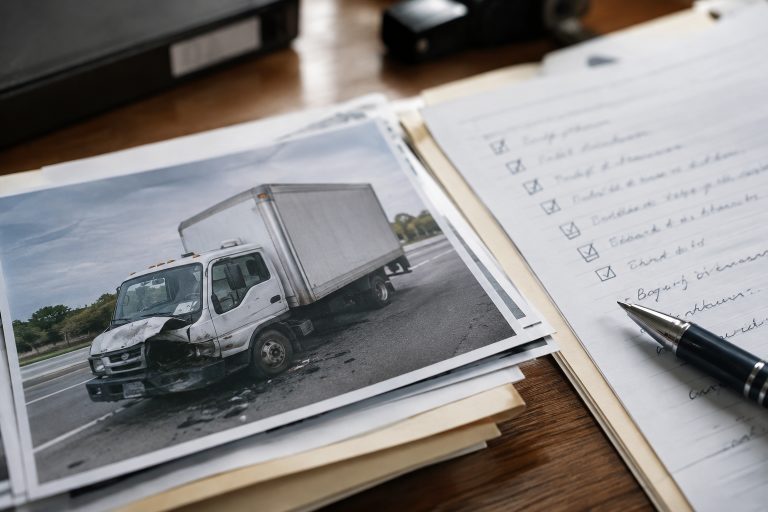
Records and Information to Preserve
- Photographs of vehicles, debris, skid marks, road conditions, lane markings, and traffic signals.
- The truck’s license plate, trailer number, company name, and USDOT number.
- Witness names, phone numbers, and written observations.
- Dashcam footage, traffic-camera footage, and video from nearby businesses.
- Driver logs, dispatch communications, route information, and electronic logging data.
- Inspection reports, maintenance records, repair records, and tire or brake documentation.
- Cargo manifests, bills of lading, weight records, and loading documents.
Federal trucking rules address issues such as driving time and required rest periods. The hours-of-service rules for commercial drivers may become relevant when an investigation raises questions about fatigue, scheduling, or the accuracy of a driver’s recorded duty status.
Investigations can also involve video, vehicle information, roadway conditions, and company safety practices. For example, the National Transportation Safety Board’s review of a multivehicle collision involving stopped traffic examined driver-monitoring video, work records, road messaging, and carrier oversight.
Potentially Responsible Parties
The truck driver may be one focus of a claim, but the available evidence may point to other parties as well. Responsibility depends on the facts, contracts, conduct, and applicable law.
- The truck driver, if unsafe driving, distraction, impairment, fatigue, or another action contributed.
- The motor carrier or trucking company, if its hiring, training, supervision, scheduling, or safety practices were deficient.
- The truck or trailer owner, leasing company, or maintenance provider.
- A cargo shipper, broker, or loading company if improperly loaded or unsecured cargo played a role.
- A manufacturer if a defective vehicle component contributed to the collision.
- A public entity or contractor if a roadway condition, traffic-control issue, or construction-zone condition is implicated.
Losses and Damages to Document
The financial effects of a fatal collision can extend well beyond the initial emergency response. Families may need records that show both direct expenses and the practical ways in which the death affected the household’s financial security and daily life.
- Medical bills and emergency transportation expenses.
- Funeral and burial costs.
- Lost income and employment benefits.
- Financial support the deceased would reasonably have provided.
- Household services, caregiving, and other contributions the person made to the family.
- Property damage and transportation costs.
Handling Insurance Communications
It is reasonable to report the crash to the appropriate insurer, but families do not need to speculate about fault, speed, injuries, or the meaning of evidence. A short, accurate report is generally safer than a detailed statement made before the facts are known.
- Keep claim numbers, letters, emails, and voicemail messages in one place.
- Read releases, authorizations, and settlement documents carefully before signing.
- Do not assume an early settlement offer accounts for every loss.
- Ask for clarification when a request for records or a document is unclear.
Why Timing Matters
Deadlines can apply to wrongful death claims, estate-related claims, insurance matters, and claims involving government entities. Some evidence may also be overwritten, repaired, discarded, or become harder to locate over time. Seeking qualified legal guidance early can help a family evaluate deadlines and send appropriate requests to preserve relevant records.
Questions Families Commonly Ask
Does a citation prove who is legally responsible?
Not necessarily. A citation may be relevant, but civil responsibility is usually determined through a fuller review of evidence and applicable law.
What if the truck driver denies fault?
A driver’s statement is only one piece of information. Vehicle damage, witness testimony, video, electronic data, and company records may provide a more complete account.
Can a trucking company be responsible for a driver’s conduct?
It may be, depending on the driver’s relationship with the company and the company’s own actions or policies. Each case requires a fact-specific review.
Conclusion
Wrongful death truck accident claims in Atlanta require sensitivity as well as careful investigation. Families should first focus on supporting one another, then preserve records, avoid premature assumptions, document expenses, and seek guidance on their legal options. A thoughtful response can help protect the information needed to pursue accountability when the time is right.
