

How Future-Ready IT Infrastructures Are Driving Business Success
Key Takeaways
- Modern, future-ready IT infrastructures are essential for staying ahead in rapidly changing industries.
- Core technologies include cloud computing, edge computing, and composable architecture for ultimate adaptability.
- AI and automation streamline decision-making, leading to increased operational efficiency and enhanced data-driven insights.
- Continuous skill enhancement and measurement of business outcomes drive lasting value from IT investments.
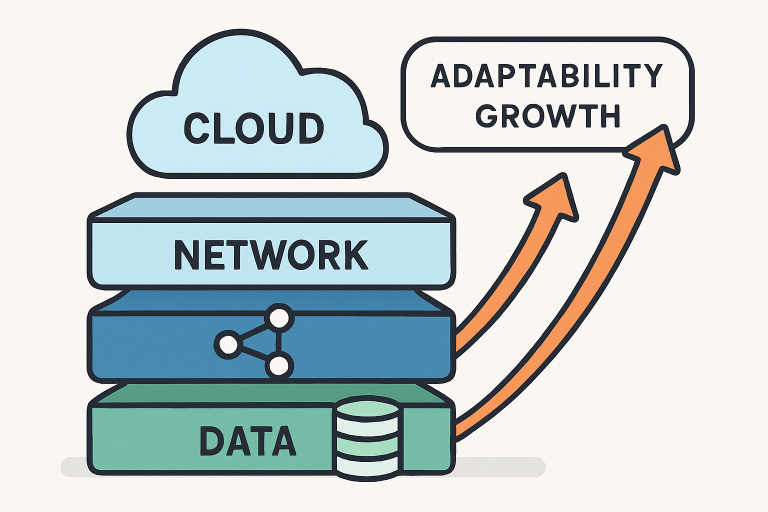
In today’s digital-first economy, the success of any business hinges on its ability to adapt swiftly and leverage emerging technologies for sustainable growth. Modern businesses are under constant pressure to innovate while maintaining lean and competitive operations. To accomplish this, leaders are investing in future-ready IT infrastructures—systems designed not just for today’s needs, but for tomorrow’s opportunities. With the expertise of partners like CIO Solutions, organizations are aligning technology with business goals, enabling them to meet new market challenges head-on.
From startups to global enterprises, a resilient IT backbone empowers companies to scale, respond to customer demands, and foster innovation. Migrating to modern IT environments is no longer a matter of “if,” but “how quickly.” These efforts enhance agility, allowing businesses to seize opportunities before their competitors.
Embracing Cloud Computing
Cloud computing has fundamentally transformed the way organizations manage and deploy technology resources. Instead of relying on costly, on-premises hardware, businesses tapping into cloud services experience unparalleled flexibility and speed. This allows them to roll out new applications quickly, scale services on demand, and facilitate easy collaboration among remote teams. According to the Business Times Journal, American organizations are increasingly utilizing cloud consulting to leverage the benefits, ensuring their infrastructure is prepared for rapid change.
The ability to store and analyze vast amounts of data, support hybrid workforces, and access advanced tools—all while reducing capital expenditure—makes the cloud a foundational ingredient in a future-ready IT strategy. Cloud platforms also streamline disaster recovery and help ensure business continuity, critical factors in today’s risk-heavy environment.
Integrating Edge Computing
While cloud computing centralizes data resources, edge computing brings analysis and action closer to where data is generated. By processing information locally, organizations can significantly reduce latency and generate real-time insights—essential for industries such as healthcare, manufacturing, and retail, where split-second decision-making is crucial. Smart sensors on factory lines or IoT devices in stores can instantly react to events without waiting for instructions from a distant data center.
This approach enables greater operational efficiency and minimizes bandwidth usage, allowing businesses to deliver personalized experiences more quickly. As noted by reputable outlets such as Forbes, edge computing is a linchpin for digital transformation, driving innovation and enabling intelligent automation at the network’s edge.
Adopting Composable Infrastructure
Composable infrastructure is gaining traction among IT leaders who aim to achieve elastic scalability without waste. This design abstracts compute, storage, and networking resources, allowing them to be quickly assembled and re-allocated, much like modular building blocks. Businesses can optimize resources for current workloads, then redeploy or scale components as new demands arise, ensuring costs are contained while maximizing agility.
Unlike traditional static systems, composable models prevent over-provisioning, reducing unnecessary expenses and environmental impact. Technology.org highlights how this strategy is at the forefront of adapting IT services to match fast-paced advances in business needs and digital solutions.
Investing in AI and Automation
Artificial intelligence (AI) and automation are pivotal in driving business transformation, empowering companies to intelligently automate routine processes and extract actionable insights from complex datasets. Organizations that proactively invest in AI experience a direct impact on productivity and profitability, streamlining workflows, tailoring customer service, and enabling faster, data-driven decision-making.
However, scaling AI from pilot projects to enterprise-wide solutions can be challenging without a robust, flexible infrastructure. According to Computer Weekly, the most successful companies are those that enable their network and infrastructure teams to support widespread adoption of AI.
Continuous Improvement and Employee Training
Sustainable success in the digital era demands a continuous learning mindset. Progressive organizations invest in upskilling their IT teams, ensuring employees are equipped to handle emerging technologies and evolving security challenges. Future-ready businesses measure IT initiatives not just by uptime or technical success, but by their effect on broader business objectives such as customer satisfaction and growth.
Regularly refining systems and processes ensures that technology efforts stay closely aligned with strategic goals. According to the Harvard Business Review, companies that make ongoing learning and adaptability central to their IT culture are best positioned for long-term gains.
Conclusion
Creating a future-ready IT infrastructure is crucial for organizations seeking to remain competitive in an increasingly dynamic business landscape. By adopting advanced technologies such as cloud and edge computing, organizations can scale efficiently, respond quickly to market shifts, and ensure operational resilience. Leveraging composable infrastructure enables greater flexibility and modularity, while integrating AI enhances decision-making, automation, and innovation across various processes. Equally important is investing in employee development, ensuring teams have the skills to maximize technological potential. Partnering with trusted experts provides guidance and best practices throughout this transformation. Companies that adopt these strategies today position themselves to drive growth, outperform their competitors, and become the success stories of tomorrow.
Visit the rest of the site for more interesting and useful articles.
