
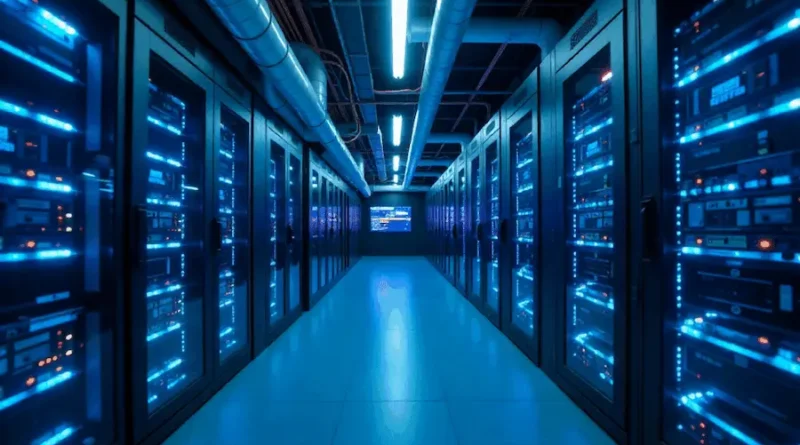
Optimizing Data Center Efficiency: Strategies for Sustainable Performance
Today, organizations face increasing pressure to enhance data center efficiency amid rising energy demands, limited budgets, and sustainability goals. The growth of cloud computing, edge deployments, and AI forces IT leaders to balance performance, resource efficiency, and cost management. Innovations such as small form factor solutions, automation, and energy-efficient infrastructure are transforming operations by enhancing density, reducing power usage, and increasing uptime. Achieving a sustainable data center is an ongoing effort that requires a holistic strategy—combining advanced technology, smart resource management, and best practices to build long-term resilience and stay competitive.
Server Consolidation: A Path to Energy Efficiency
Server consolidation remains a fundamental strategy for improving efficiency in today’s data centers. By migrating workloads from a sprawling mix of underutilized, aging servers to a smaller number of high-density, high-performance systems, companies can achieve impressive savings in both energy and floor space. The modernization journey often starts with adopting newer server models in a compact 1U chassis, allowing IT staff to provision more computing power per square foot and significantly reduce overhead. Not only can this switch result in up to 60% less energy consumption, but it also simplifies management and reduces the risk of hardware failures and unplanned outages. For future-focused businesses, these gains free up resources for innovation and enable more flexible scaling.
Enhancements such as server virtualization and hyper-converged infrastructure take consolidation even further, enabling multiple virtual workloads to coexist seamlessly on a single robust platform. By streamlining physical infrastructure, these solutions reduce hardware investment and eliminate redundant energy expenditures, while also enhancing business resilience and disaster recovery. Automated orchestration further ensures workloads can move dynamically between nodes, enabling adaptive scaling in response to fluctuating demand. This consolidated, virtualized approach enables organizations to significantly enhance their sustainability metrics while reducing excessive energy usage and cooling loads.
Advanced Cooling Technologies for Thermal Management
Ensuring IT hardware stays cool and at optimal temperatures is vital for reducing risks and maintaining efficiency. Cooling systems once made up a large part of data center energy consumption, with traditional air conditioning often failing to keep up with dense, modern server setups. Now, data centers can adopt advanced cooling solutions designed to boost energy savings and prevent thermal hotspots. Technologies like direct-to-chip liquid cooling and rear-door heat exchangers effectively transfer heat away from electronics, outperforming air-based methods and supporting higher-density deployments without overheating. Liquid cooling is especially ideal for environments with very high rack densities or workloads—such as AI training—that produce a lot of heat.
Environmental factors also offer greener cooling options. Facilities in colder areas, for instance, can use free air cooling, which relies on outside air to dissipate heat most of the year, significantly lowering HVAC expenses. Additionally, economizer systems and improved airflow management can further cut reliance on traditional mechanical cooling.
AI-Driven Workload Management
Artificial intelligence has emerged as a transformative driver for maximizing efficiency and reducing waste in data center environments. Today’s AI-infused management platforms continuously gather and analyze data from sensors, server logs, application metrics, and even external conditions, such as weather or power grid status. These intelligent platforms utilize machine learning models to predict resource needs, automatically distribute workloads, and power off idle servers, leading to sustained operational savings and enhanced reliability. Autonomous workload balancing enables IT staff to focus on higher-level tasks, rather than routine manual optimization, resulting in better performance with less hands-on intervention.
Examples from industry giants are compelling. Google, for instance, reported cooling energy reductions of up to 40% through the use of AI. By leveraging predictive analytics and feedback loops, AI systems can not only cut operational costs but also dynamically adapt to unexpected workload shifts or hardware issues. These advancements pave the way for responsive, self-optimizing data centers—minimizing wasted energy while maintaining high service quality at all times.
Modular and Edge Data Centers: Enhancing Scalability
As enterprise needs rapidly evolve, building traditional data centers from the ground up can be both prohibitively expensive and too slow for today’s fast-paced business climate. In response, more companies are embracing modular data centers—standardized, pre-assembled units that can be shipped and installed quickly to meet growth or changes in demand. These modular units drastically reduce deployment times, simplify construction planning, and provide consistent, high-efficiency power and cooling management from day one. Because they can scale up or down as needed, modular architectures are ideal for growing companies, startups, and organizations experimenting with new locations or workloads.
Edge data centers are designed to bring compute, storage, and analytics capabilities closer to the source of data generation—reducing latency, improving user experiences, and alleviating stress on core facilities. By processing data at the edge, organizations can support latency-sensitive applications, provide real-time insights for IoT devices, and enhance business continuity during network disruptions. The benefits extend beyond speed and responsiveness: edge deployments also ease the burden on central data centers, improving efficiency for both infrastructure types and enabling better resource allocation across the enterprise.
Conclusion
Creating and maintaining an efficient data center is a comprehensive effort that requires integrating several modern technologies and operational strategies. By leveraging high-density server options, incorporating efficient cooling systems, and implementing AI-driven management tools, organizations can significantly enhance their use of power, floor space, and human resources. Modular and edge architectures provide further support for adaptability, business resiliency, and meeting evolving customer demands across multiple markets.
Ultimately, organizations that pursue these best practices are well-positioned to lower their environmental footprints, reduce operational expenditures, and build data centers capable of meeting future needs. The result: data centers that not only power the business but also protect the planet and foster sustainable growth for years to come.
Visit the rest of the site for more interesting and useful articles.
