
Eschopper: What It Is, Why You Need One, and How to Choose (2026)
What is an Eschopper? (Direct Answer First)
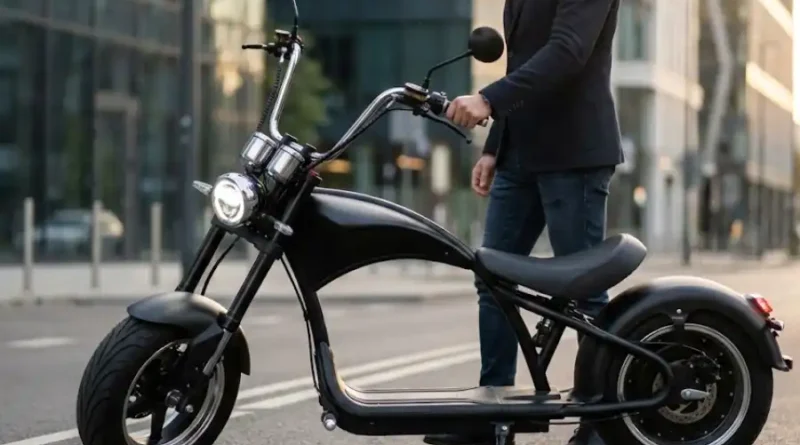
An eschopper is an electric motorcycle-style scooter that combines the design of a classic motorcycle chopper with modern electric motor technology.
It’s not a standing scooter. It’s a seated vehicle with a low frame, wide handlebars, fat tires (10-12 inches wide), and an electric motor (typically 500W-3500W). You sit on it like a motorcycle, feet on pegs, and twist the throttle to accelerate.
Think of it this way: Take the iconic look of a Harley-Davidson chopper, long, low, rebellious, and replace the roaring gas engine with a silent, powerful electric motor. That’s an eschopper.
Key Eschopper Components Explained
The Frame: Long and low, designed for a relaxed, laid-back riding position. This is different from standing scooters like Xiaomi or Segway models.
The Motor: A hub motor mounted in the rear wheel. Power ranges from 500 watts (entry-level) to 3,500+ watts (performance models). More watts = faster acceleration and better hill climbing.
The Battery: Lithium-ion pack, usually removable so you can charge it indoors. Capacity ranges from 1,000Wh to 2,500+Wh. More capacity = longer range per charge.
The Tires: Wide, chunky tires (10-12 inches) provide stability, comfort, and traction on city streets. Better grip than thin tires, especially in wet conditions.
The Brakes: Hydraulic disc brakes are standard on quality models. Some budget models use mechanical discs or drum brakes—avoid these.
Smart Features: LED lights, digital dashboard, regenerative braking (recaptures energy when you brake), and smartphone apps for tracking and locking.
What’s the Difference Between an Eschopper and Other Electric Vehicles?
Eschopper vs. Standing E-Scooter (Like Xiaomi or Segway)
| Feature | Eschopper | Standing E-Scooter |
|---|---|---|
| Riding Position | Seated (motorcycle style) | Standing |
| Comfort | High (long rides) | Low (standing tires) |
| Weight/Power | 1,000W-3,500W | 250W-1,000W |
| Range | 40-120 km per charge | 20-50 km per charge |
| Price | $800-4,500 | $300-800 |
| Top Speed | 25-60+ km/h | 15-40 km/h |
| Best For | Commuting, long trips | Short trips, light use |
Eschopper advantage: Comfort for longer rides, more power, better range, bigger tires for rough surfaces.
Eschopper vs. E-Bike
E-Bike:
- You pedal with electric assist
- Lighter, slower, smaller
- Requires physical effort
- More affordable ($500-2,500)
Eschopper:
- You don’t pedal; twist-and-go throttle
- Heavier, faster, larger
- Requires zero physical effort
- More expensive ($800-4,500)
Bottom line: Eschoppers are for people who want motorcycle-like performance without pedaling. E-bikes are for those who want assisted pedaling.
Eschopper vs. Gas Scooter/Moped
Gas Scooter:
- Loud engine
- Requires fuel
- Needs regular maintenance (oil, spark plugs, gearbox)
- Produces emissions
- Cheaper upfront (sometimes)
Eschopper:
- Silent motor
- Requires electricity only
- Almost no maintenance
- Zero emissions
- Costs less over time
Verdict: Eschoppers win on operating costs, maintenance, and environmental impact.
Why Are Eschoppers Becoming Popular? (Market Trends)
Reason 1: They Save Real Money Every Month
How much can you save?
If you currently commute by car:
- Car costs per month: Gas ($60-100) + Insurance ($100-200) + Parking ($200-300) + Maintenance ($40-50) = $400-650 per month
If you switch to an eschopper:
- Eschopper costs per month: Electricity ($5-10) + Insurance ($0-10) + Maintenance ($0-5) = $5-25 per month
The math: $400-650 (car) minus $15 (eschopper average) = $385-635 saved per month
Break-even calculation: A $2,000 eschopper pays for itself in about 4 months. After that, you’re saving pure money.
Real-world example: Marcus in Melbourne commutes 12 km daily on a $1,800 mid-range eschopper. He previously paid $180/month for parking, $120/month for fuel, and $50/month for maintenance. Total: $350/month. Now he pays $8/month in electricity. Annual savings: $4,096.
Reason 2: You Actually Enjoy Your Commute
Psychological benefit: Most eschopper users report higher job satisfaction and reduced commute stress.
People switch from cars and say: “I actually look forward to my commute now instead of dreading it.”
Why? Because:
- You feel the fresh air and sunlight (not trapped in a metal box)
- You’re in control of navigation, not sitting passively
- It feels fun and adventurous, not tedious
- Silent electric motors are peaceful, not stressful
This affects your mental health, stress levels, and overall happiness. That’s worth something.
Reason 3: They’re Practical for Modern Cities
Parking nightmare solved: A car needs a parking spot. An eschopper fits in a bike rack, against a wall, or even under your desk.
Traffic evasion: You can navigate around stopped cars, use bike lanes (where legal), and often reach your destination faster than a car in congested cities.
No emissions: You’re not contributing to air pollution. In cities like Delhi, Beijing, and Los Angeles that choke on smog, this matters.
Quiet operation: Electric motors are nearly silent. You’re not polluting soundscapes. Neighbors thank you.
Easy to move: A 50-pound eschopper is manageable. A car requires valet or luck finding a spot.
Reason 4: Accessible to More People Than Motorcycles
Motorcycle requirements:
- Special license (motorcycle endorsement)
- Years of riding experience often expected
- High insurance costs
- Steep learning curve
Eschopper requirements:
- Regular driver’s license (in most places)
- No riding experience necessary
- Cheap/no insurance
- Easy to learn (most people comfortable in 30 minutes)
Demographic shift: Seniors, people with disabilities, and young people who can’t ride motorcycles now have access to fast, independent transportation. That’s genuinely transformative.
How Much Does an Eschopper Cost? (Full Breakdown)
Purchase Price (Initial Investment)
Entry-Level Eschopper: $800-1,500
- Motor: 500W-1,000W
- Range: 30-50 km per charge
- Top speed: 25-32 km/h
- Best for: Short commutes under 5 km, beginners, legal compliance-focused regions
Mid-Range Eschopper: $1,500-2,500
- Motor: 1,500W-2,500W
- Range: 50-80 km per charge
- Top speed: 40-48 km/h
- Best for: Regular 10-25 km commutes, mixed terrain
- Most popular choice for daily commuters
Performance Eschopper: $2,500-4,500+
- Motor: 3,000W+
- Range: 70-120 km per charge
- Top speed: 50-60+ km/h
- Best for: Long 30+ km commutes, hilly cities, maximum performance
Monthly Operating Costs (Year 1)
Using a $1,800 mid-range eschopper example:
- Electricity: $5-10/month (compared to $80-120 on gas)
- Maintenance: $0-5/month (nothing year 1, typically)
- Insurance: $0-10/month (optional or very cheap in most places)
- Parking: $0 (free almost everywhere)
Total running cost: $5-25 per month
Add upfront cost amortized: ($1,800 ÷ 12 months) + $15 = $165/month total Year 1
Compare to car: $250-400/month. You break even around month 4-5.
Year 2+ Operating Costs
After year 1, you own it outright.
Only costs:
- Electricity: $5-10/month
- Brake pad replacement: $30-50 every 2-3 years = $10-15/month average
- Occasional tire replacement: $50-100 per tire every 3-5 years = $5-10/month average
- Battery replacement: Optional after 5-7 years, costs $300-800
Year 2+ monthly cost: $20-35/month
Annual savings vs. car: $4,000-7,000
What Types of Eschoppers Exist? (Classification Guide)
Entry-Level Electric Choppers (500W-1000W)
Who should buy: Beginners, short commutes, legal-compliance first countries
Performance specs:
- Top speed: 15-20 mph (25-32 km/h)
- Range: 19-31 miles (30-50 km) per charge
- Motor power: 500-1,000 watts
- Battery capacity: 1,000-1,500 Wh
- Weight: 40-50 lbs
- Acceleration: Moderate (0-20 mph in 5-8 seconds)
Real example: Jessica in London has a 500W model for her 2 km commute to the train station. Trip takes 8 minutes. Cost per trip: Less than 1 cent. She feels refreshed, not frustrated by traffic.
Pros:
- Affordable ($800-1,500)
- Legal everywhere (even restrictive regions)
- Lightweight and portable
- Requires minimal maintenance
Cons:
- Limited range (only good for short trips)
- Struggles on steep hills
- Slower acceleration
- Not suitable for long commutes
Mid-Range Electric Choppers (1500W-2500W)
Who should buy: Regular commuters, mixed terrain, balanced budget/performance
Performance specs:
- Top speed: 25-30 mph (40-48 km/h)
- Range: 31-50 miles (50-80 km) per charge
- Motor power: 1,500-2,500 watts
- Battery capacity: 1,500-2,000 Wh
- Weight: 55-75 lbs
- Acceleration: Strong (0-20 mph in 3-5 seconds)
Real example: Marcus in Melbourne commutes 7.5 miles (12 km) daily on a 1,500W eschopper. Commute takes 20 minutes. He saves $150/month on parking. Monthly cost: $8.
Pros:
- Sweet spot of price ($1,500-2,500) and performance
- Good for most commutes (10-25 km daily)
- Climbs hills easily
- Comfortable suspension and build quality
- Fast enough for mixed traffic
Cons:
- Heavier than entry-level
- Requires a license in many places (speed-dependent)
- Not quite as affordable as entry-level
Performance Electric Choppers (3000W+)
Who should buy: Long commutes, hilly terrain, maximum performance seekers
Performance specs:
- Top speed: 30-40+ mph (50-65+ km/h)
- Range: 43-75 miles (70-120 km) per charge
- Motor power: 3,000+ watts
- Battery capacity: 2,000-2,500+ Wh
- Weight: 75-90+ lbs
- Acceleration: Extreme (0-20 mph in 2-3 seconds)
Real example: David in San Francisco has a 3,000W eschopper. His commute covers steep hills (15% grades). Regular motors struggle; his doesn’t. Investment: $3,000. Monthly savings: $300+. Payoff period: 10 months.
Pros:
- Maximum power and range
- Climbs 20%+ grades without effort
- Fastest acceleration and top speed
- Best for long-distance commuting
- Premium build quality
Cons:
- Expensive ($2,500-4,500+)
- Often requires motorcycle license
- Heaviest option
- Overkill for short commutes
How Do I Choose the Right Eschopper? (Decision Framework)
Step 1: Calculate Your Daily Commute Distance
Under 5 km one-way? → Entry-level eschopper is fine. Save money.
5-15 km one-way? → Mid-range is the sweet spot. You need adequate power and range.
15+ km one-way or hilly terrain? → Performance model. Don’t cheap out. You need the power.
Why it matters: A 1000W motor on a 15% hill is terrifying. A 2500W motor laughs at it. Specs aren’t just numbers; they’re safety.
Step 2: Assess Your Terrain
Flat city streets? Entry or mid-range works.
Some hills (5-10% grade)? Mid-range recommended.
Steep hills (10%+ grade)? Performance model mandatory.
How to find your grade: Search “elevation change [your commute route]” on Google Maps. If you see sustained climbs, you need power.
Step 3: Determine Your Charging Situation
Option A: Garage or apartment with an outlet?
- Get a removable battery model
- Charge at home or office
- No moving the scooter
- Easiest setup
- All mid-range and high-end models support this
Option B: No charging access?
- Get maximum battery capacity (1,500+ Wh)
- Plan your charging strategy
- Charge at work, coffee shops, gyms with outlets
- Consider portability of battery if removable
Option C: Need to charge at work?
- Ensure battery is removable
- Bring it to your desk/locker
- Look for compact models
Step 4: Check Local Laws First (Before Buying)
This is critical. Different regions have different rules:
United States:
- Most states: Under 500W, under 20 mph = no license needed
- California: E-bikes/scooters under 750W, 20 mph = legal in bike lanes
- Some cities: Ban all e-scooters from public areas
- Check your city’s municipal code
European Union:
- Most countries: Under 250W = no license
- Over 250W = usually requires moped license
- Helmets often mandatory for higher-speed models
UK:
- Currently: E-scooters technically illegal on public roads (confusing situation)
- Check local council guidance
- Expected legal changes in 2026
Why this matters: You could spend $2,000 on a 2500W model only to find it’s illegal where you live. Check first.
How to check: Search “e-scooter laws [your city]” or visit your local Department of Transportation website.
Step 5: Set Your Budget
Be realistic. Don’t go broke to look cool.
Budget-conscious ($800-1,500)?
- Entry-level model
- Short commutes only
- Acceptable build quality
- Legal everywhere
Mid-range sweet spot ($1,500-2,500)?
- Most popular choice
- Balanced performance and price
- Good build quality
- Handles most commutes
Premium performance ($2,500-4,500+)?
- Maximum capability
- Long commutes or hills
- Best build quality
- Worth it if you use daily
What Are the Key Specs to Actually Care About?
1. Range (Real-World, Not Marketing Claims)
What manufacturers claim: Their ideal range in perfect conditions (flat terrain, light rider, eco mode, 70°F weather).
Real-world range: Typically 70-80% of claimed range.
Example: An eschopper claims “100 km range.” Expect 70-80 km actual.
Why it matters: If you commute 20 km daily, a claimed 100 km range = 70-80 km real range = comfortable. You have 3-4x buffer.
What to do: Read user reviews on Reddit, YouTube, and forums. Real riders test in real conditions.
How range is measured: Watt-hours (Wh). A 1,500 Wh battery gives you roughly 1 km per 15-20 Wh depending on motor efficiency, terrain, and weight.
2. Motor Power (in Watts)
What it means: How hard the motor can push.
- 500-1000W: City riding, flat streets, beginner-friendly, legal everywhere
- 1500-2500W: Mixed terrain, some hills, regular commuting, best balance
- 3000W+: Mountains, long distance, maximum performance
Common misconception: “More watts = better”
Truth: More watts drain battery faster and might be illegal where you live.
Rule of thumb: Get what you actually need. A 500W motor on a 10 km flat commute is perfect. A 500W motor on a 20% hill is dangerous.
3. Battery Capacity (Wh or Ah)
This is your fuel tank.
- 1,000 Wh: Short trips only, city riding
- 1,500-2,000 Wh: Regular commuting (10-25 km daily)
- 2,500+ Wh: Long commutes (25+ km daily) or extended range
What to look for:
- Brand-name cells (LG, Samsung) = reliable
- Reputable Battery Management System (BMS) = safe
- At least 1,500 Wh for commuting = practical
Battery lifespan: 5-7 years with proper care. After that, capacity degrades 15-20%.
4. Brakes (Critical for Safety)
Drum brakes: Old, weak, unreliable. Avoid.
Mechanical disc brakes: Better, but requires maintenance and adjustment.
Hydraulic disc brakes: Best. Consistent stopping power, minimal maintenance, reliable in rain.
Rule: Never buy an eschopper with anything less than hydraulic disc brakes. Brakes are safety. Don’t compromise.
5. Suspension (Comfort Matters)
No suspension: Your bones feel every bump. Uncomfortable on rough streets.
Front suspension only: Better than nothing. Okay for light city riding.
Full suspension (front and rear): Smooth, comfortable, worth the upgrade if you ride regularly.
Types:
- Spring suspension: Simple, affordable
- Air suspension: Adjustable, responsive, premium
- Hydraulic damping: Smooth, refined
What Does It Actually Feel Like to Ride an Eschopper?
The Acceleration
You twist the throttle. For a microsecond, nothing. Then—instant torque. No engine rev-up time. No shifting gears. Pure electric power.
On a 1500W motor, acceleration from 0-20 mph (0-32 km/h) takes 3-5 seconds. Feels quick without being extreme.
At a red light, you accelerate off the line faster than most cars. That’s a real feeling.
The Range Anxiety Question
Fear: “What if my battery dies while I’m riding?”
Reality: It rarely happens to regular commuters.
Why?
- Modern models show battery % on display
- You learn your range in a few weeks (becomes automatic)
- Most avoid riding below 20% (smart planning)
Example: Your eschopper range is 50 km. Your commute is 20 km. You’re never going to run out. Even if you used 40% of range one way, you’d still have 30 km left for the return.
The Silence
Electric motors are quiet. You hear wind and tire sound, not engine roar.
Benefit: You can listen to music, podcasts, or your thoughts. You can hear approaching traffic (safety plus).
Compare to: Sitting in traffic with engines roaring around you. The quiet of an eschopper feels peaceful by comparison.
Weather Reality Check
Rain: Most eschoppers are splash-resistant, not waterproof. Light rain? Fine. Heavy rain or puddles? Skip it.
Cold: Lithium batteries lose 20-30% capacity in freezing weather. Plan for shorter range in winter.
Wind: You’ll feel wind more than in a car, less than on a bicycle. You’re in control.
Snow/Ice: Don’t ride. Not worth it. Fat tires help, but slipping on ice isn’t safe.
How Do I Maintain an Eschopper? (It’s Easier Than You Think)
Weekly Maintenance (5 minutes)
Check tire pressure. Underinflated tires waste battery and make riding uncomfortable.
Verify lights work. Brake light, headlight, any turn signals. Safety critical.
Listen for unusual sounds. Squeaks, clicks, grinding. These indicate problems early.
That’s it. Weekly maintenance takes 5 minutes total.
Monthly Maintenance (15 minutes)
Inspect for loose bolts. Vibration can loosen fasteners over time.
Check brake pad wear. Look at the thickness. If less than 2mm, plan replacement soon.
Clean the motor area. Dirt and debris can accumulate. Wipe clean with a dry cloth.
Verify all cables are secure. Brake cables, throttle cable, power cables.
Annual Maintenance (Professional)
Have a professional:
- Inspect the brake system completely
- Check battery for damage or swelling
- Test motor performance
- Torque all major bolts
- Clean electrical connections
Cost: Usually $50-100 for a full inspection.
Every 2-3 Years
Brake pad replacement: $30-50 per set
Tire replacement: $50-100 per tire (rarely needed if you maintain pressure)
Compare this to car maintenance: Oil changes ($30-50), air filters ($20-40), transmission fluid ($100-200), coolant flushes ($100-150). Eschoppers are dramatically simpler.
Battery Care (Critical for Longevity)
Bad charging habits kill batteries:
Don’t: Leave at 0% regularly (kills cells) Don’t: Charge to 100% every day (degrades capacity) Don’t: Leave plugged in overnight every night (trickle-charging damages it) Don’t: Charge in extreme heat or cold
Do: Charge when battery hits 20% Do: Charge to 80% for daily use (only to 100% when you need extra range) Do: Unplug when full Do: Charge at room temperature (70°F/21°C is ideal) Do: Store at 50% charge if unused for weeks
Battery lifespan: 5-7 years with proper care. Bad habits? 2-3 years.
How Safe Is Riding an Eschopper? (Honest Assessment)
Real Risks
Risk 1: Traffic accidents (highest risk)
- Drivers don’t always see scooters
- Higher speed increases impact severity
- Blind spots and sudden turns dangerous
Risk 2: Road hazards
- Potholes, gravel, and wet surfaces more dangerous on two wheels than cars
- Fat tires help, but don’t eliminate risk
Risk 3: Rider error
- Inexperienced riders oversteer or brake too hard
- Speed misjudgment on unfamiliar roads
How to Mitigate Risks
Mandatory safety gear:
- Helmet (non-negotiable)
- Motorcycle helmet, DOT or ECE certified
- $100-300 for a good one
- Brain damage vs. $200 investment = obvious choice
- Full-finger gloves
- Hands are first things to hit ground
- Abrasion-resistant materials
- $20-50
- Jacket
- Abrasion-resistant, armored
- Protects arms and shoulders
- $50-150
- Bright clothing or reflective gear
- Visibility saves lives
- Make yourself impossible to miss
- Lights on your scooter
- Bright LED headlight (1000+ lumens)
- Tail light and brake lights
- Turn signals if available
Riding Techniques for Safety
Before corners: Brake in a straight line. Brake and turn simultaneously = instability.
Through corners: Brake before, then roll on throttle mid-turn for smooth tracking.
At intersections: Assume drivers don’t see you. Make eye contact. Don’t proceed until sure.
Wet roads: Modulate brakes smoothly. Avoid sudden braking. Rear brake is safer than front in rain.
Low visibility: Use all lights. Assume you’re invisible. Act accordingly.
Speed: 30-45 km/h is the safe city speed. Faster = higher impact forces.
Extreme weather: Ice, heavy rain, snow? Don’t ride. It’s not worth it.
Real Statistics
According to NHTSA (US Department of Transportation):
- Scooter injuries: Mostly minor (scrapes, small fractures)
- Serious injury rate: Lower than motorcycles, higher than e-bikes
- Death rate: Extremely rare with proper safety gear
Bottom line: An eschopper with proper gear and smart riding is reasonably safe. Without gear? It’s reckless.
Does an Eschopper Require a License? (Legal Status)
The honest answer: It depends on where you live and what model you have.
United States
Federal rule doesn’t exist. States and cities make their own rules.
Most common (California, New York, others):
- Under 500W motor = no license needed
- Under 20 mph = no license needed
- If both under those limits = treat like e-bike
Higher-power models (1500W+):
- Often require moped or motorcycle license
- Varies by state
- Some states don’t have a clear classification yet
What to do:
- Search “e-scooter laws [your state]” + “[your city]”
- Call your local DMV
- Check city municipal code
- Ask a local dealer (they know the rules)
European Union
General rules (with exceptions):
- Under 250W = no license
- Under 25 km/h = no license
- Over both = usually moped license required
Country variations:
- Germany: Strict enforcement, licensing common
- Netherlands: More relaxed, but rules exist
- France: 25 km/h limit without license
- Always check your specific country
United Kingdom
Current status: Confusing and changing (2026)
- E-scooters technically illegal on public roads
- Legal only in specific trials and private land
- Expected new regulations coming soon
- Check local council website
China
Largely unregulated, widely used. Most eschoppers come from Chinese manufacturers (Eahora, NIU, CSC). Laws are evolving.
Why This Matters
Scenario: You buy a $2,000 performance eschopper, then discover it’s illegal where you live without a motorcycle license you don’t have.
Prevention: Check the law first. It takes 10 minutes and saves regret.
What’s the Real Cost of Ownership Over 5 Years?
Scenario: Mid-Range Eschopper ($2,000)
Year 1:
- Purchase: $2,000
- Electricity: $60 (5/month × 12)
- Maintenance: $0 (none typically needed)
- Insurance: $60 (if required; often $5/month)
- Year 1 total: $2,120
Year 2:
- Electricity: $60
- Maintenance: $20 (minimal)
- Insurance: $60
- Year 2 total: $140
Year 3:
- Electricity: $60
- Maintenance: $40 (brake pads replacement)
- Insurance: $60
- Year 3 total: $160
Year 4:
- Electricity: $60
- Maintenance: $20
- Insurance: $60
- Year 4 total: $140
Year 5:
- Electricity: $60
- Maintenance: $80 (potential tire replacement, battery check)
- Insurance: $60
- Year 5 total: $200
5-Year Total Cost: $2,760
Cost per month (5-year average): $46/month
Compare to Car (Same 5 Years)
Year 1:
- Purchase (used car): $8,000
- Gas: $1,000/year
- Insurance: $1,500/year
- Maintenance: $500/year
- Parking (if applicable): $2,400/year
- Year 1 total: $13,400
Years 2-5: Average $400/month = $1,920/year = $7,680 total
5-Year Total: $21,080
Cost per month (5-year average): $351/month
The Math
- Eschopper 5-year cost: $2,760 ($46/month)
- Car 5-year cost: $21,080 ($351/month)
- Difference: $18,320 saved (87% reduction)
This is why eschopper owners switch and never look back.
Who Makes Eschoppers? (Popular Brands)
Budget Brands ($800-1,500)
Eahora X7 / X9
- Chinese manufacturer
- Reliable, solid reviews
- Entry-level to mid-range
- Good customer service
Pro: Affordable Con: Heavier, not as refined
Mid-Range Brands ($1,500-2,500)
NIU (Ninebot)
- Chinese brand, popular globally
- Good build quality
- Removable batteries
- Strong warranty support
CSC Motorcycles (CityScooter)
- German engineering, Chinese manufacturing
- Premium feel, good suspension
- Higher price point
- Excellent after-sales support
Performance Brands ($2,500-4,500+)
Dualtron (Minimotors)
- Premium Korean brand
- Extreme performance models
- Dual motors available
- Expensive but best-in-class
Kaabo Mantis
- High performance
- Strong acceleration
- Premium build
- Expensive
How to Choose a Brand
Consider:
- Warranty: 2-3 years minimum
- Support: Can you reach customer service? Is there local repair?
- Parts availability: Can you get replacement parts easily?
- Reviews: What do actual owners say?
- Return policy: What if it arrives damaged?
Red flag: Brands with no customer service, impossible return policies, or no reviews. Stick to established brands.
Should You Buy an Eschopper? (Final Decision Framework)
Yes, If:
✓ You commute 5-30 km regularly (perfect distance range) ✓ You spend $100+ monthly on transportation (ROI is fast) ✓ You live in a city with mixed traffic, bike lanes, parking challenges ✓ You care about environment and want to reduce carbon footprint ✓ You want to enjoy your commute instead of endure it ✓ You can legally own one (checked local laws first) ✓ You have somewhere to store it (apartment, garage, office corner) ✓ You’re comfortable on two wheels (basic motorcycle confidence needed)
No, If:
✗ You commute 50+ km daily (beyond practical range) ✗ You live in extreme cold year-round (battery loses 30%+ capacity) ✗ You need to carry heavy cargo regularly (e-scooters aren’t cargo vehicles) ✗ You’re nervous on two wheels (requires real motorcycle confidence) ✗ Your city is very hilly and budget is tight (need powerful = expensive) ✗ You live somewhere rural (eschoppers are city vehicles) ✗ Weather is frequently severe (rain, snow, ice = unsafe) ✗ It’s illegal where you live (don’t buy if not legal)
Where to Buy an Eschopper (Buying Guide)
Option 1: Online Retailers
Popular sites: Amazon, eBay, brand websites (Eahora, NIU, CSC, Dualtron)
Pros:
- Lower prices (no middleman markup)
- Home delivery
- Easy to compare
- Customer reviews
Cons:
- No test ride
- Shipping damage possible
- No local support if something breaks
- Returns/shipping can be expensive
How to buy safely:
- Check seller reviews (4.5+ stars minimum)
- Read recent customer reviews (last 30 days)
- Verify warranty coverage
- Check return policy before buying
- Use credit card (buyer protection)
Option 2: Local Electric Bike Shops
Where to find: Search “electric scooter shop near me” or “e-bike retailer [your city]”
Pros:
- Test ride before buying (critical!)
- Local support and service
- Same-day pickup
- Expert advice
Cons:
- Higher prices (retail markup)
- Limited selection
- Business hours limited
Why test-riding matters: Comfort, throttle feel, suspension smoothness—these are personal. What feels right to you might be wrong for someone else.
What to Look For in a Seller
Warranty:
- Frame: Minimum 1 year
- Motor: Minimum 1 year
- Battery: Minimum 2 years (this is the expensive part)
Customer Service:
- Can you reach them by phone/email?
- Do they respond quickly?
- Do they actually help with problems?
Return Policy:
- Can you return if DOA (dead on arrival)?
- What’s the window? (30-60 days minimum)
- Who pays return shipping?
Local Support:
- Is there a repair center in your area?
- Can they fix it if something breaks?
- Do they have spare parts in stock?
Red flags: No phone number. No response to emails. No reviews. Suspiciously cheap. If something feels off, it probably is.
What’s the Future of Eschoppers? (2026 and Beyond)
Predicted Improvements
Better Batteries (2027-2028)
- Current: 1,500-2,000 Wh is standard
- Future: 2,500-3,500 Wh likely
- Benefit: 100+ km range becomes normal
- Technology: Solid-state batteries in development
Smarter Electronics
- Current: Basic throttle, dashboard
- Future: AI-integrated assist, traffic awareness
- Integration with smartphone, city apps
- Real-time data about bike health
Better Safety Features
- Anti-theft GPS tracking becoming standard
- Collision detection and warning systems
- Automatic brake assist (like cars)
- Lights that detect and respond to surroundings
Clearer Regulations
- Currently: Confusing, varies by region
- Expected: Standardized legal classifications
- Safety standards becoming consistent
- Insurance more streamlined and affordable
Customization Culture Growing
- Like motorcycles, eschopper customization is exploding
- Custom paint jobs, seats, handlebars
- Performance upgrades and modifications
- Community forums and clubs emerging
Market Growth
Current situation (2026): Eschoppers are niche but growing.
Predicted (2030): Mainstream alternative to cars in cities.
Why: As prices drop and quality improves, adoption accelerates. First-mover advantage for early buyers.
Common Questions People Ask
“Can I ride an eschopper in rain?”
Short answer: Light rain, yes. Heavy rain or puddles, no.
Explanation: Most eschoppers are splash-resistant (IP54-IP55 rating), not waterproof. Electronics can fail if fully submerged. Light drizzle? Fine. Riding through puddles? Risky.
“How long does the battery last?”
Short answer: 5-7 years with proper care. Degradation accelerates after that.
Explanation: Lithium batteries gradually lose capacity. After 5-7 years, you’ll notice 15-20% range loss. That’s normal. If you want original performance, replace the battery ($300-800).
“Is it safe for beginners?”
Short answer: Yes, with proper training and gear.
Explanation: Eschoppers are easier to learn than motorcycles. Most people feel comfortable in 30 minutes. The key is starting on quiet streets, wearing full protective gear, and practicing low-speed maneuvers first.
“What if I fall?”
Short answer: With proper gear, injuries are usually minor. Without gear, injuries can be severe.
Explanation: Falls happen. It’s part of riding. But a helmet prevents brain injury, gloves prevent hand destruction, and a jacket prevents road rash. Gear is non-negotiable.
“Can two people ride one eschopper?”
Short answer: Only if the model is designed for passengers.
Explanation: Some eschoppers have seats rated for two people. Others don’t. Check the specifications. If it’s not designed for passengers, don’t force it. You’ll overload the suspension and motor, creating safety issues.
“What happens if the motor fails?”
Short answer: You can coast and brake normally. Walk it home.
Explanation: If the motor cuts out, it’s not dangerous. You have brakes. You can safely stop and walk the scooter home. Motor failures are rare with quality models.
“Is it worth it if I only commute once per week?”
Short answer: Probably not.
Explanation: Eschoppers make financial sense for daily or 3-4x per week users. Battery degrades even if not used. Insurance and maintenance are fixed costs. Once-per-week use = slow payoff period. A regular bike or occasional taxi might be smarter.
“Can I take it on public transportation?”
Short answer: Sometimes, depends on the system.
Explanation: Some city buses have bike racks that accept scooters. Some trains allow them in designated cars. Some systems prohibit them entirely. Check your local transit authority rules.
“How do I store it long-term?”
Short answer: Charge to 50%, store dry and cool, check monthly.
Explanation: Long-term storage (3+ months) requires care. Charge battery to 50% (not 0%, not 100%). Store in cool, dry place (40-70°F). Check monthly and recharge if needed. This preserves battery health.
Final Thoughts: Is an Eschopper Worth It?
The honest assessment: An eschopper is one of the best investments you can make in your daily life—if the conditions are right.
What you get:
- Saves $3,000-5,000 per year vs. car commuting
- 20-30 minute payback period on investment
- Commute you actually enjoy instead of endure
- Reduced environmental impact
- Independent mobility without licenses or skills
- Simple, almost maintenance-free operation
What you need:
- Regular commute (10-30 km daily, ideally)
- City environment with mixed traffic
- Ability to ride safely on two wheels
- Access to charging (removable battery is easiest)
- Local laws that permit the model you want
- Commitment to safety gear and smart riding
The decision: If you commute daily in a city and spend $100+ monthly on transportation, an eschopper pays for itself in 4-6 months. After that, you’re saving pure money every month while enjoying your commute.
For many people, that’s a no-brainer.
Test one out. See how it feels. Talk to owners in your city. Then decide based on your specific situation, not general hype.
You might find that best money you ever spend on transportation.
Visit the rest of the site for more interesting and useful articles.
