
How to Choose the Right Google Ads Agency for Your Business
Google Ads is one of the fastest ways to put your business in front of people who are already searching for what you sell. With rising click costs and more competition in almost every industry, every wasted dollar hurts more than it did a few years ago. A strong agency turns that pressure into opportunity by helping you win better traffic at a sustainable cost.
If you already know your strategy is strong but your main bottleneck is ad account stability, you can work with specialized providers that offer pre‑warmed Google agency ad accounts; in that case, you might simply decide to buy from Uproas rather than relying on a single fragile in‑house account.
This guide is built to remove that guesswork. You will see how to define realistic goals, what a good Google Ads agency really does, which questions to ask on discovery calls, and which red flags to avoid. Use it as a checklist while you talk to potential partners so you can compare them on facts, not promises.
Understand What You Really Need from a Google Ads Agency
Before you compare agencies, get clear on what “success” looks like for your business. An agency can only build a smart strategy if it knows whether you care most about leads, online sales, booked calls, store visits, or market share.
Define Your Business Goals and KPIs
Write your goals in numbers, not vague wishes. For example, “increase qualified leads from 50 to 120 per month at a target CPA of X” is much clearer than “get more leads.”
- Lead‑generation businesses should look at cost per lead, lead quality, and sales conversion rate.
- E-commerce brands should focus on ROAS, average order value, and customer lifetime value.
- Local businesses should include call volume, bookings, and store visits tracked via location extensions.
Agencies that ask detailed questions about margins, sales process, and lifetime value are usually better equipped to build profitable campaigns.
Decide Your Budget, Timelines, and Internal Capacity
Your Google Ads spend and timeline will shape which agencies are a realistic fit. Many high‑quality teams have minimum monthly budgets or management fees because they invest time into strategy, testing, and reporting.
Be honest about:
- How much can you invest in ad spend and management for at least 3–6 months?
- Whether you have in‑house marketing support for landing pages, creative, and content.
- How quickly you need results vs how much room you have for testing and optimization.
The right Google Ads agency should push back on unrealistic timelines or underfunded plans instead of saying yes to everything.
Know What a Great Google Ads Agency Actually Does
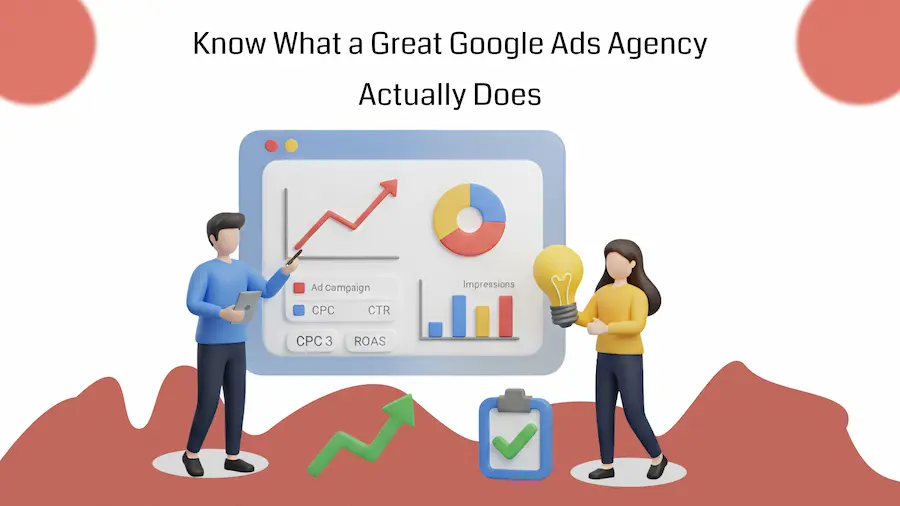
Many businesses think a Google Ads agency just “pushes buttons” in the interface. In reality, the best teams blend strategy, data, creative thinking, and ongoing experimentation.
Core Responsibilities You Should Expect
A serious Google Ads agency should handle more than keyword bids. At a minimum, expect:
- Strategic planning based on your goals and market.
- Keyword and audience research, including negatives and match‑type planning.
- A campaign and account structure that separates themes, locations, and intent levels.
- Ad copywriting and creative testing across variants.
- Conversion tracking, including calls, forms, and ecommerce events.
- Ongoing optimization, A/B testing, and bid strategy adjustments.
- Regular reporting with clear recommendations, not just raw data.
If an agency cannot clearly explain what is included in their Google Ads management services, treat it as a warning sign.
How They Use Different Campaign Types
Today’s Google Ads ecosystem includes Search, Shopping, Performance Max, Display, Video, Local, and remarketing campaigns. A good agency will not simply turn everything on; it will choose formats that match your funnel and goals.
For example, ecommerce brands may combine Search and Performance Max with Google Shopping and dynamic remarketing, while B2B companies may lean on high‑intent Search and remarketing to nurture longer sales cycles. Ask each agency to explain which campaign types they would prioritize for your scenario and why.
Shortlist Agencies Based on Fit, Not Hype
Most comparison mistakes happen before the first sales call. Shortlist agencies that actually match your size, industry, and way of working instead of chasing the biggest logo list.
Check Industry and Business‑Model Experience
Agency experience in your space reduces the learning curve and guesswork. Look for case studies, testimonials, or examples from businesses that resemble yours in:
- Industry and niche.
- Price point and sales cycle length.
- Lead‑generation vs e-commerce vs subscription models.
An agency that excels with low‑ticket ecommerce might not be the right Google Ads agency for a high‑ticket B2B service that requires multiple touchpoints. Ask for examples where they scaled accounts with similar constraints to yours (margins, regulations, seasonality).
Match Their Structure to Your Size and Geography
Small local businesses may need a nimble team that understands local search and limited budgets, while larger brands may require deeper reporting, multi‑region campaigns, and cross‑channel coordination. Decide whether you need:
- A boutique Google Ads agency that can offer closer contact with senior strategists.
- A larger performance marketing agency with dedicated specialists and more resources.
- A local partner that understands your region’s nuances, if you rely heavily on local customers.
Pro tip: during discovery calls, notice how well they understand your market without you having to over‑explain the basics.
Verify Expertise, Not Just Badges
Google Partner or Premier Partner badges, years in business, and a shiny website are table stakes, not proof that they can grow your account. You need evidence of thinking, execution, and results.
Certifications, Case Studies, and Real Numbers
Google Partner status shows that an agency manages enough spend and maintains basic performance thresholds, but it does not guarantee strategic excellence. Use it as a filter, not a final decision.
Ask to see:
- Case studies with before‑and‑after KPIs (CPC, conversions, CPA, ROAS).
- Screenshots or anonymized dashboards that show trends, not one‑week spikes.
- Testimonials that mention specific outcomes, not just “great team.”
If they refuse to show any numbers or hide behind NDAs for everything, be cautious.
Who Actually Works on Your Account
Many agencies close deals with senior experts and then hand accounts to juniors with minimal oversight. Clarify:
- Who will be your day‑to‑day account manager?
- How many accounts does each manager handle?
- How often do senior strategists review your campaigns?
You want a structure where experienced people regularly look at your data, not just at renewal time.
Evaluate Their Strategy, Data, and Testing Mindset
The right Google Ads agency for your business will have a clear, test‑driven process rather than a collection of tricks. The way they answer strategic questions tells you more than any badge.
How They Build Your Strategy from Day One
In early calls, listen carefully to the questions they ask. Good signals include:
- Asking about your margins, sales cycle, existing traffic sources, and sales process.
- Wanting access to past ad accounts or analytics to learn from historical data.
- Discussing negative keywords, segmentation, and early test hypotheses.
Weak agencies jump straight into talking budgets and keywords without understanding how your business actually makes money.
How They Optimize and Test Over Time
Ask each agency how they manage performance over the first 90 days. Strong answers mention:
- Structured A/B tests on ad copy, landing pages, and audiences.
- Progressive tightening of keywords and placements based on search term reports.
- Adjusting bidding strategies as data volume grows (e.g., moving from manual CPC to target CPA or target ROAS where it makes sense).
They should be able to explain this clearly, without drowning you in jargon. If they talk only about “optimizing” without naming concrete levers, be careful.
Demand Transparency on Budget, Fees, and Ownership
One of the most common mistakes when hiring a Google Ads agency is focusing only on headline management fees and ignoring how money and data actually flow. Transparency is non‑negotiable.
Understand How They Charge and What You Get
You will typically see one of three pricing models:
- Percentage of ad spend.
- Flat monthly fee.
- Hybrid or performance‑linked fee.
Compare offers not just on the fee but on the work included: reporting depth, meeting cadence, creative testing, and strategic support. The cheapest option often cuts corners on all of these, leading to higher CPAs in the long run.
Clarify Account Ownership and Access
You should always retain ownership of the Google Ads account, historical data, and conversion tracking setup. Avoid arrangements where the agency runs everything under a master account; you lose if the relationship ends.
Ask for:
- Admin access to your account.
- Clear documentation of campaigns, audiences, and tracking.
- The ability to export data and switch providers without disruption.
This protects you from being locked into an underperforming partner.
Check Communication, Reporting, and Cultural Fit
Even the best strategy fails if you cannot get clear answers or timely updates. Your Google Ads agency becomes an extension of your team, so the relationship has to work at a human level.
Reporting Cadence and Clarity
Ask how often you will receive performance reports and what they will include. A solid reporting rhythm usually combines:
- Monthly deep‑dive reports with trends and commentary.
- Shorter updates when major tests go live or big shifts happen.
- A shared understanding of which KPIs matter most to you.
Avoid agencies that send 40‑page PDFs full of vanity metrics without clear insights or next steps.
Day‑to‑Day Communication and Proactivity
You should know who your point of contact is, how to reach them, and how quickly they respond. Ask for examples of times they proactively suggested changes rather than just reacting to client complaints.
High‑quality agencies bring ideas, tests, and optimizations to you before you ask; low‑quality ones only move when you raise concerns.
Red Flags When Choosing a Google Ads Agency
Some signs are strong enough that you should walk away. Recognizing these early saves you money and time.
Promises and Behaviors to Avoid
Be cautious if an agency:
- Guarantees a specific ROAS, number of leads, or rankings before seeing your data.
- Refuses to give you admin access to your own account.
- Pushes one‑size‑fits‑all packages instead of tailored strategies.
- Cannot explain what they are doing in plain language.
- Leans heavily on Google’s automated recommendations without critical testing.
These patterns often show that the agency is more focused on closing deals than responsibly managing its spend.
How to Run Discovery Calls and Compare Agencies
Once you have a shortlist, use structured discovery calls to compare agencies on more than just “vibes.” Treat each call as a working session where you assess thinking, communication, and transparency.
Smart Questions to Ask Every Agency
Here are practical questions that reveal how an agency operates:
- “What do your Google Ads management services include each month?”
- “How would you structure campaigns for a business like mine, and why?”
- “What does your first 90 days with a new client usually look like?”
- “How do you handle conversion tracking and offline data?”
- “Can I see case studies from similar businesses, with real metrics?”
Pay as much attention to how they answer as to what they say: the best agencies are specific, honest about trade‑offs, and comfortable saying “we would need to test that.”
Use a Simple Scoring Sheet
After each call, score agencies across a few dimensions:
- Strategic thinking and business understanding.
- Experience with your industry and model.
- Transparency on fees, access, and reporting.
- Communication style and responsiveness.
This avoids emotional decisions based on the most charismatic salesperson.
Set Up the Relationship for Long‑Term Success

Choosing the right Google Ads agency is step one; how you work together determines long‑term results. Treat onboarding as a joint project, not a quick handover.
Onboarding and Expectations
Agree upfront on:
- Target KPIs and acceptable ranges during the testing phase.
- Reporting frequency and meeting cadence.
- Who provides landing pages, creative, and copy?
- How quickly changes can be requested and deployed.
It often helps to think in 90‑day blocks: first 30 days for setup and early tests, days 30–90 for optimization and scaling winners.
Where Google Ads Fits into Your Wider Growth Strategy
The right Google Ads agency for your business will never treat paid search in isolation. It should help you connect ad performance with your website, SEO, social media, and brand assets.
Pairing Google Ads with Social Proof and Profiles
A strong paid search program works better when prospects see consistent proof of credibility on social channels. If your strategy leans on Instagram, TikTok, YouTube, or Twitter to build trust and awareness, your agency may recommend coordinating campaigns with dedicated social media growth services so your paid traffic sees strong follower counts and engagement.
In that context, pointing readers toward focused services such as social media growth services for Instagram and TikTok can help brands shore up their profile credibility before driving large volumes of paid search traffic.
Combining Paid Search with SEO and Content
Many growth teams use Google Ads to test which keywords and messages convert, then invest in ranking organically for the proven winners. A strategic agency will often suggest a complementary SEO link-building strategy so high‑performing search terms from ads can turn into long‑term organic traffic and lower acquisition costs.
A marketplace like Linkscope, where you can plan and buy targeted backlinks and guest posts, fits naturally into this conversation when explaining how paid search insights inform content and off-page SEO plans.
Aligning Ad Messaging with Your Social Profiles and Content
Prospects who click your ads often check your social profiles and content before converting, especially in creator‑driven or service‑based niches. The right Google Ads agency should care about how your bios, channel names, and content support the story your ads tell.
Here, resources like social media content and bio guides from Socialmelo can help you refine profiles and messaging so your ad traffic sees a consistent, trustworthy brand presence across Google, YouTube, and social platforms. For YouTube creators specifically, tools like YouTube channel name generators can ensure your channel identity aligns with the paid traffic you’re driving.
Quick Checklist: Is This the Right Google Ads Agency for Your Business?
Use this as a final filter before you sign:
- They understand your goals, margins, and sales process, and can state them back clearly.
- They explain their strategy, optimization process, and pricing in simple, concrete terms.
- They give you admin access to your account and clean, regular reports.
- They showcase studies and results from similar businesses.
- They act like a partner who questions assumptions, not a vendor who agrees with everything.
Choose the Google Ads agency that challenges you intelligently, respects your budget, and is willing to be transparent about how they plan to earn your trust over time.
Visit the rest of the site for more interesting and useful articles.
