

Key Elements of a Winning Digital Marketing Strategy for Small Businesses
It’s tough out there for small businesses. The online world is crowded, and getting noticed feels harder than ever. Many businesses try different online tactics, but without a clear plan, these efforts can fall flat.

A digital marketing strategy is simply your roadmap. It’s a detailed plan of action that uses online channels to reach your specific audience and achieve your business goals. Instead of guessing, you have a clear direction.
Why is this so important? The truth is, almost half of all organizations – 49% to be exact – don’t have a defined digital marketing strategy. This often leads to wasted time and money. We believe every small business deserves a reliable plan to guide their efforts. Building a Trusted digital marketing strategy means moving beyond random acts of marketing. It ensures every step you take online works towards a bigger objective.
This guide will show you how to build that winning strategy. We will cover everything from understanding your audience to choosing the right channels and measuring your success. By the end, you’ll see how strategy, campaigns, and tactics work together to drive real results.
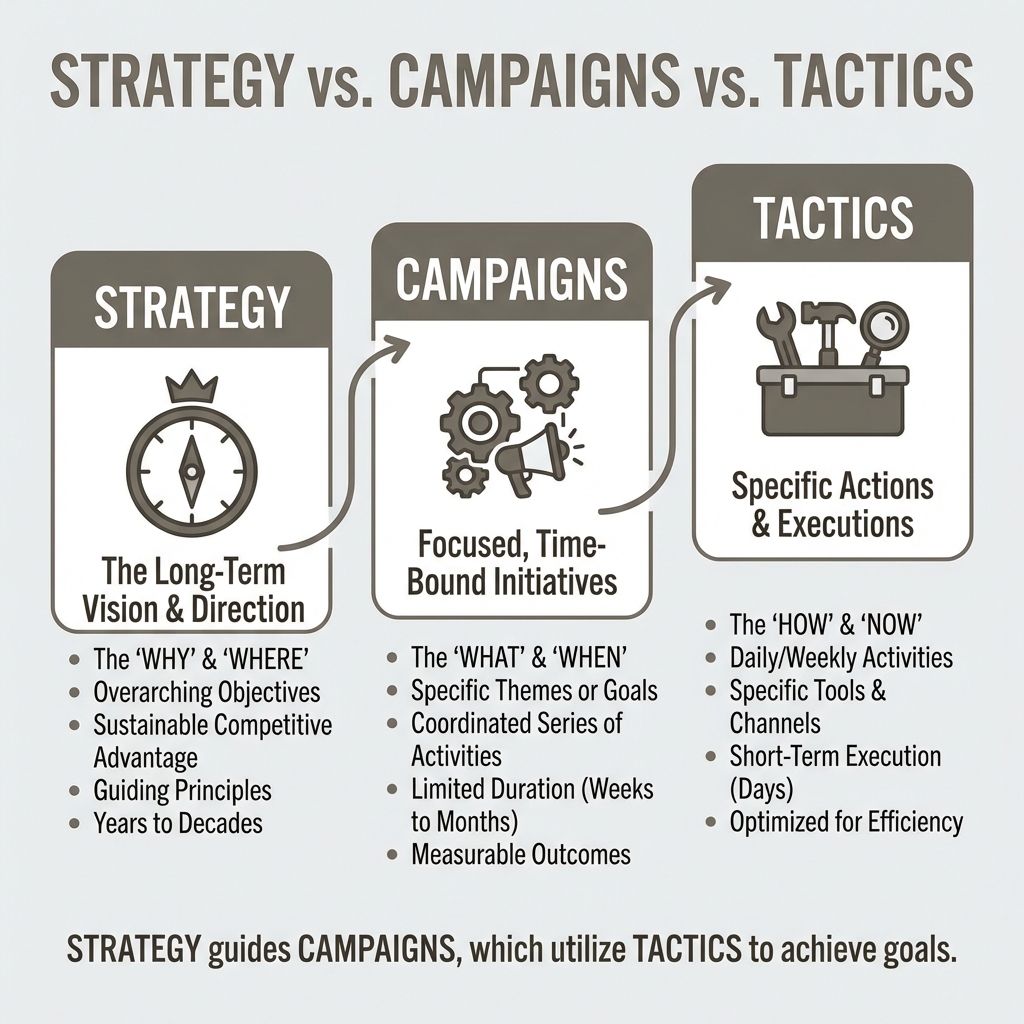
Every successful digital marketing strategy begins with a solid foundation. This involves clearly defining your core objectives, understanding who you’re trying to reach, and mapping out their journey with your brand. Without these foundational elements, your efforts will lack direction and impact.

At the heart of any effective strategy are four core components: Goals, Audience, Budget, and Metrics. These elements are interconnected and must be established before diving into specific tactics. Our journey begins with setting clear, actionable goals.
We advocate for the SMART framework when setting goals:
- Specific: Clearly define what you want to achieve. Instead of “increase sales,” aim for “increase online sales of product X by 15%.”
- Measurable: Ensure you can track progress and quantify success.
- Achievable: Set realistic goals that are within your reach.
- Relevant: Your goals should align with your overall business objectives.
- Time-bound: Assign a deadline to create urgency and a clear endpoint for evaluation.
Once your goals are set, the next critical step is understanding the Customer Value Journey. This journey outlines the path a prospect takes from first becoming aware of your business to becoming a loyal advocate. It typically involves several stages:
- Awareness: The prospect first learns about your brand.
- Engagement: They interact with your content or brand in some way (e.g., reading a blog, watching a video).
- Subscribe: They opt-in to receive more information (e.g., email newsletter).
- Convert: They make their first small commitment (e.g., a low-cost purchase, a demo sign-up).
- Excite: They have a positive first experience with your product or service.
- Ascend: They become repeat customers, making larger or more frequent purchases.
- Advocate: They speak positively about your brand when asked.
- Promote: They actively spread the word about your brand without being prompted.
Each stage requires different marketing efforts and content. Documenting this entire plan—from your SMART goals to the customer journey—is essential. A clear, actionable plan ensures everyone on your team understands the direction and their role. Reviewing a framework like RJP’s digital strategy can show how these elements are structured into a cohesive and effective marketing blueprint, providing a valuable example of strategic organization.
How to Define Your Audience for Your Digital Marketing Strategy
Understanding your audience is paramount. It’s not enough to say “everyone.” Small businesses thrive when they focus their resources on the people most likely to become their customers. This involves in-depth target audience research.
We dig into several aspects:
- Demographics: Age, gender, income, education, location, occupation. These are the basic facts about your audience.
- Psychographics: Their interests, hobbies, values, attitudes, and lifestyle. What motivates them? What are their aspirations?
- Pain Points: What problems do they face that your product or service can solve? What challenges keep them up at night?
Using this research, we create buyer personas. These are semi-fictional representations of your ideal customers, based on real data and some educated speculation about demographics, behavior patterns, motivations, and goals. For example, “Eco-Conscious Emily” might be a 30-year-old professional, concerned about sustainability, who researches product origins before buying.
These personas are invaluable. They guide your content creation, helping you tailor your messaging, choose the right channels, and develop products that truly resonate with your target market. When you know who you’re talking to, you can speak directly to their needs and desires, building a stronger connection and driving more effective marketing outcomes.
Choosing Your Channels: A Small Business’s Digital Marketing Strategy
Once you have a clear understanding of your goals and your audience, the next step is to select the most effective digital channels to reach them. The digital landscape offers a vast array of options, and it’s crucial for small businesses to choose wisely to maximize their impact without overstretching their resources. We often categorize digital media into three main types: Owned, Earned, and Paid.
- Owned Media: These are the digital properties your business controls entirely. This includes your website, which serves as your central hub, your blog, where you can publish valuable content, and your social media profiles. Owned media allows you to control your message, build your brand identity, and directly engage with your audience.
- Earned Media: This refers to exposure gained through promotional efforts other than paid advertising. It’s essentially word-of-mouth marketing in the digital age. Examples include customer reviews on platforms like Google or Yelp, PR mentions in online publications, and social shares of your content. Earned media is highly credible because it comes from third parties, but it’s also the hardest to control.
- Paid Media: This encompasses any digital marketing effort that you pay for. Common examples include PPC (Pay-Per-Click) advertising on search engines like Google, social media ads on platforms like Facebook and Instagram, and influencer marketing where you pay individuals to promote your products. Paid media offers immediate reach and precise targeting capabilities, allowing you to get your message in front of specific segments of your audience quickly.
Understanding how these three types of media intersect and complement each other is key to a comprehensive strategy. For instance, content created on your owned media can be promoted through paid media and, if compelling enough, can generate earned media.
Now, let’s explore some core digital marketing tactics that are particularly effective for small businesses:
- Content Marketing: This involves creating and distributing valuable, relevant, and consistent content to attract and retain a clearly defined audience. For small businesses, this means providing answers to common questions, offering helpful tips, and sharing insights related to your industry. This can take the form of blogs, videos, guides, infographics, or podcasts. The goal is to build trust and establish your business as an authority, which in turn drives leads and sales.
- Search Engine Optimization (SEO): SEO is the process of optimizing your website and content to rank higher in search engine results pages (SERPs). When potential customers search for products or services you offer, you want your business to appear prominently. Effective SEO improves your visibility and drives organic traffic (unpaid visitors) to your site. For small businesses, Local SEO is particularly important, ensuring you appear in search results for customers in your geographic area.
- Social Media Marketing: Social media platforms offer powerful opportunities to build community, engage directly with your audience, and showcase your brand personality. The key is to choose the right platforms where your target audience spends their time. Whether it’s Instagram for visual brands, LinkedIn for B2B services, or Facebook for broader community engagement, active and strategic social media presence can foster relationships and drive traffic. More than 1 million new people join social media platforms every day, highlighting the immense reach these channels offer.
- Email Marketing: Despite the rise of social media, email remains one of the most effective channels for nurturing leads and driving conversions. It allows for highly personalized communication, enabling you to send targeted messages based on customer behavior, preferences, and their stage in the customer journey. Effective segmentation of your email list can significantly increase open rates and click-through rates, making your email campaigns highly efficient.
By strategically combining these tactics and leveraging Owned, Earned, and Paid media, small businesses can build a robust digital presence that attracts, engages, and converts their ideal customers.
Executing, Measuring, and Adapting Your Plan
A brilliant digital marketing strategy is only as good as its execution and its ability to adapt. The digital world is constantly evolving, with new trends, technologies, and consumer behaviors emerging regularly. Therefore, our approach must be dynamic, allowing for continuous monitoring, measurement, and refinement.
Implementation begins with turning your strategic plan into actionable tasks. This often involves creating a content calendar that outlines what content will be produced, when, and for which channel. Clearly assigning roles and responsibilities to team members ensures accountability and smooth workflow. Tools for project management can be invaluable here, helping to keep everything organized and on track.
Once your campaigns are live, using analytics tools becomes paramount. Platforms like Google Analytics provide deep insights into website traffic, user behavior, and conversion paths. Social media platforms also offer their own built-in social media insights to track engagement, reach, and audience demographics. These tools allow us to see what’s working, what isn’t, and where opportunities lie. For instance, we know that up to 70% of internet traffic comes from mobile devices, so analyzing mobile performance in Google Analytics is crucial.
The digital landscape’s rapid pace necessitates constant adapting to change. This means staying informed about market trends and evolving consumer behavior. What worked last year might not work today. Regular A/B testing of headlines, ad copy, call-to-actions, and landing page designs allows you to incrementally optimize your campaigns based on real user data. This iterative process is key to long-term success.
Furthermore, leveraging technology is no longer optional; it’s a competitive necessity. The role of automation and AI in digital marketing is growing exponentially. AI can help with everything from audience segmentation and content personalization to predictive analytics and ad optimization. For small businesses looking to gain an edge, exploring an AI lead generation strategy can significantly improve efficiency, allowing you to automate repetitive tasks, refine targeting, and drive measurable results faster and more economically.
Measuring the Success of Your Digital Marketing Strategy
Measurement is the feedback loop that informs adaptation. Without it, you’re flying blind. We focus on defining Key Performance Indicators (KPIs) that directly align with your SMART goals.
Common KPIs include:
- Website Traffic: The number of visitors to your site, often broken down by source (organic, paid, social, referral).
- Conversion Rate: The percentage of visitors who complete a desired action (e.g., make a purchase, fill out a form, download a guide).
- Cost Per Lead (CPL): The average cost incurred to acquire a new lead.
- Return on Investment (ROI): The financial gain or loss from your marketing efforts relative to the cost.
Tracking and reporting these KPIs should be a consistent activity. We recommend regular reviews of your performance data—weekly, monthly, or quarterly, depending on your business cycle. This allows for data-driven decisions, enabling you to reallocate budget, adjust tactics, or refine your strategy based on what the numbers tell you. The average marketing budget was just under 10% of total business revenue in 2022, so ensuring that investment yields results is critical. By consistently measuring and adapting, your digital marketing strategy becomes a powerful engine for growth, rather than a static document.
Frequently Asked Questions about Digital Marketing Strategy
As small businesses start on their digital marketing journey, several common questions arise. Addressing these can help explain the process and provide practical guidance.
How much should a small business budget for digital marketing?
There’s no one-size-fits-all answer, as the ideal budget depends heavily on your specific circumstances. However, as a general guideline, many businesses allocate a percentage of their revenue to marketing. Gartner reports that the average marketing budget was just less than 10% of total business revenue in 2022.
Factors to consider when determining your budget include:
- Business Stage: New businesses often need to invest more heavily upfront to build brand awareness and acquire initial customers. Established businesses might focus more on retention and scaling.
- Goals: Aggressive growth goals will naturally require a larger investment than modest maintenance goals.
- Industry: Highly competitive industries typically demand higher marketing spend to stand out.
- Profit Margins: Businesses with higher profit margins may have more flexibility to invest in marketing.
We recommend starting with a realistic budget that you can sustain, and then being prepared to adjust it based on the performance and ROI of your campaigns.
Which digital marketing channels are best for a new business?
For a new business, the best channels are often those that offer a good balance of low cost and high impact, and where your target audience is most active.
- SEO (Search Engine Optimization): While results take time, SEO is a long-term investment that brings in highly qualified organic traffic. Focusing on local SEO can be particularly effective for brick-and-mortar businesses.
- Content Marketing: Creating valuable blog posts, videos, or guides can establish your expertise, build trust, and attract an audience without direct advertising spend. This also supports your SEO efforts.
- Social Media Marketing: Many platforms offer free organic reach. Identify where your target audience spends their time and focus your efforts there to build a community and engage directly. More than 1 million new people join social media platforms every day, providing a vast pool of potential customers.
- Email Marketing: Building an email list from day one allows you to nurture leads and communicate directly with interested prospects at a very low cost per message.
The key is to focus on where your audience is and choose channels that align with your business model and resources, rather than trying to be everywhere at once.
How long does it take to see results from a digital marketing strategy?
The timeline for seeing results from a digital marketing strategy varies significantly by channel and tactic. It’s important to set realistic expectations.
- Paid Ads (PPC, Social Media Ads): These channels can provide almost immediate results in terms of traffic and leads, as you’re paying for visibility. However, optimizing campaigns for ROI still takes time and testing.
- SEO (Search Engine Optimization): SEO is a long-term game. It can take several months (3-6 months, sometimes longer) to see significant ranking improvements and organic traffic increases, especially for competitive keywords.
- Content Marketing: Similar to SEO, content marketing builds authority and trust over time. While individual pieces might go viral, consistent effort over months yields the best results in terms of lead generation and brand building.
- Social Media Marketing: Building a strong social media presence and engaged community is also a gradual process. While individual posts can generate quick engagement, sustained growth requires consistent effort.
The most important factor is consistency. Digital marketing is not a one-off campaign but an ongoing process. Businesses that consistently implement, measure, and adapt their strategies will see compounding results over time. Patience, coupled with continuous optimization, is key to long-term success.
Conclusion
Developing a comprehensive digital marketing strategy is no longer a luxury but a necessity for small businesses striving for growth in today’s interconnected world. We’ve explored the key elements that form its foundation: setting clear SMART goals, understanding your audience through buyer personas, and mapping their journey from awareness to advocacy.
We’ve also highlighted the diverse channels available, from owned media like your website to earned media like reviews, and paid media like targeted ads, emphasizing the core tactics of content marketing, SEO, social media, and email marketing. Crucially, we’ve underscored the importance of measurement and adaptation, urging you to continuously track KPIs, leverage analytics, and remain agile in response to market trends and evolving consumer behavior.
Digital marketing is a long-term game that rewards patience, consistency, and a data-driven approach. It’s about building relationships, providing value, and continuously optimizing your efforts. By investing time in crafting a well-planned strategy, you’re not just marketing; you’re laying the roadmap to sustainable growth for your small business. Accept the journey, stay curious, and let your strategy guide you to success.
Visit the rest of the site for more interesting and useful articles.
